Boots and Tailoring: The Forgotten Relationship That Defines Style
A lot of classic shoes Brogues, Oxfords, Derbies have origins tied to outdoor use, country use, and boot-like practicality. Early footwear often featured sturdier construction and higher coverage than the sleek, low shoes most men wear today.
David Aisosa
12/26/20253 min read
Most men misunderstand boots.
Not because they choose the wrong pair but because they fail to understand what boots demand from tailoring.
Boots are not accessories.
They are structural elements.
And when structure is misunderstood, the entire outfit collapses.
This is why so many men look “almost right” but never truly composed. The tailoring fights the footwear instead of working with it. The result is visual friction a break in harmony that the eye immediately senses, even if it cannot explain it.
This article will teach you the foundational principle behind wearing boots with tailoring correctly a principle that has existed for over a century and has quietly disappeared in modern dressing.
The Forgotten Truth: Boots Were Never Meant to Stand Alone
Historically, shoes such as brogues, derbies, and even early Oxfords were born from boots. They were built for terrain, for structure, for endurance. Their design assumed weight, presence, and physicality.
Because of this, trousers were constructed around them.
Tailoring was not an isolated garment. It was part of a system. Every element shoe, trouser, jacket communicated with the others.
What we see today is a breakdown of that system.
Men now pair heavy footwear with trousers designed for minimalism, lightness, or cropped modernity. The result is visual contradiction.
The boot says “grounded.”
The trouser says “floating.”
And when those two ideas clash, the entire look collapses.
The Core Principle: Volume Requires Space
Boots carry volume.
That volume must be respected.
When a boot enters an outfit, it introduces:
• Height
• Density
• Structural weight
This immediately changes how trousers must behave.
If the trouser does not have enough space, it will cling, stack awkwardly, or break harshly at the ankle. The eye then reads disorder rather than intention.
This is not a styling issue.
It is a structural one.
The Most Common Mistake: The “Hanging Trouser”
You see this everywhere.
The trouser sits directly on top of the boot, neither flowing nor resting with purpose. The hem collapses. The line is broken.
This creates three problems:
1. The silhouette is interrupted – the eye stops at the ankle.
2. The outfit loses authority - it appears uncertain, unfinished.
3. The boot looks heavier than it should – because it carries visual weight without balance.
When trousers simply hang on the boot, the outfit has no rhythm.
Understanding Boots Through Construction, Not Style
To dress well consistently, you must stop thinking in categories like “smart” or “casual” and start thinking in structure.
Boots fall into two functional categories:
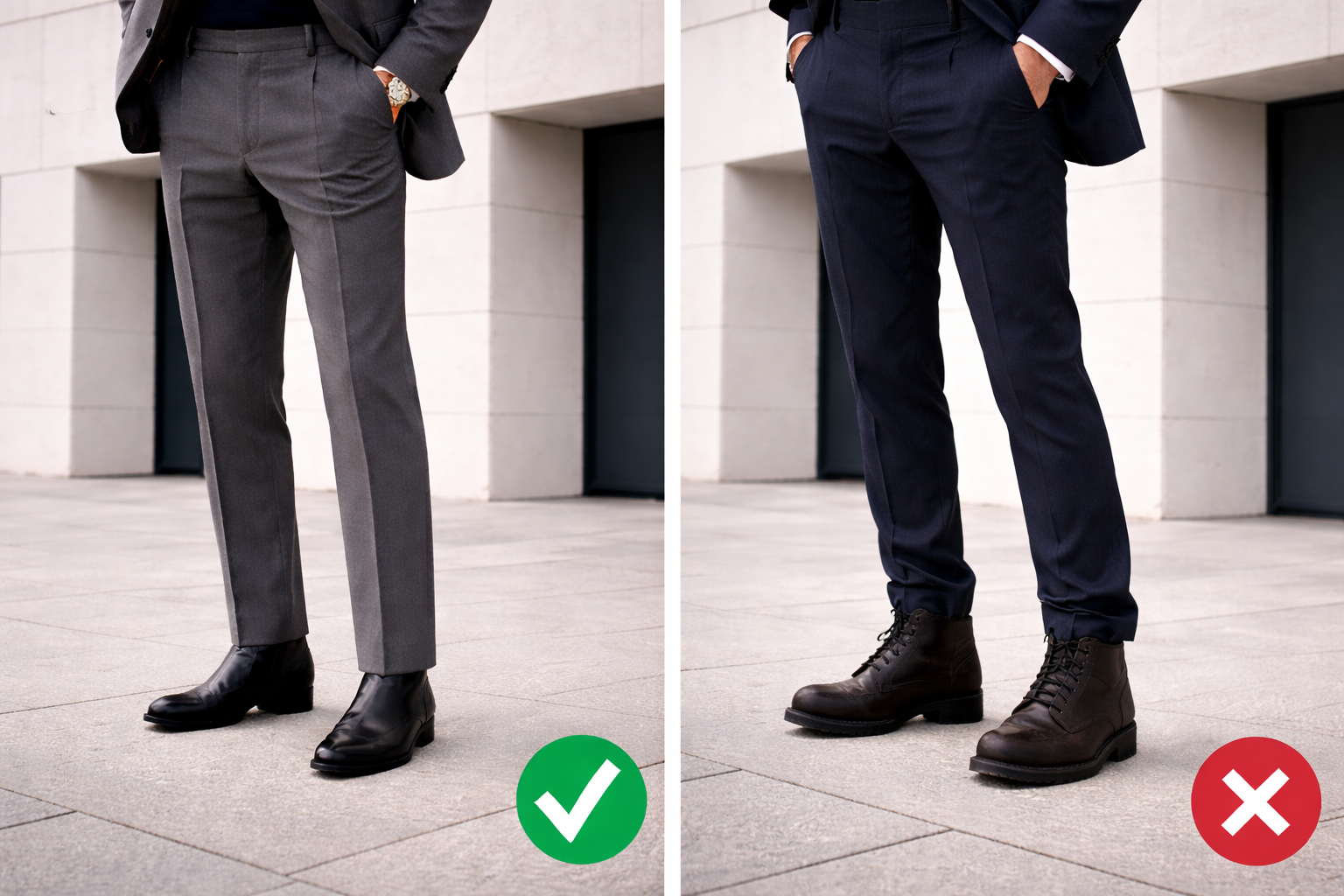
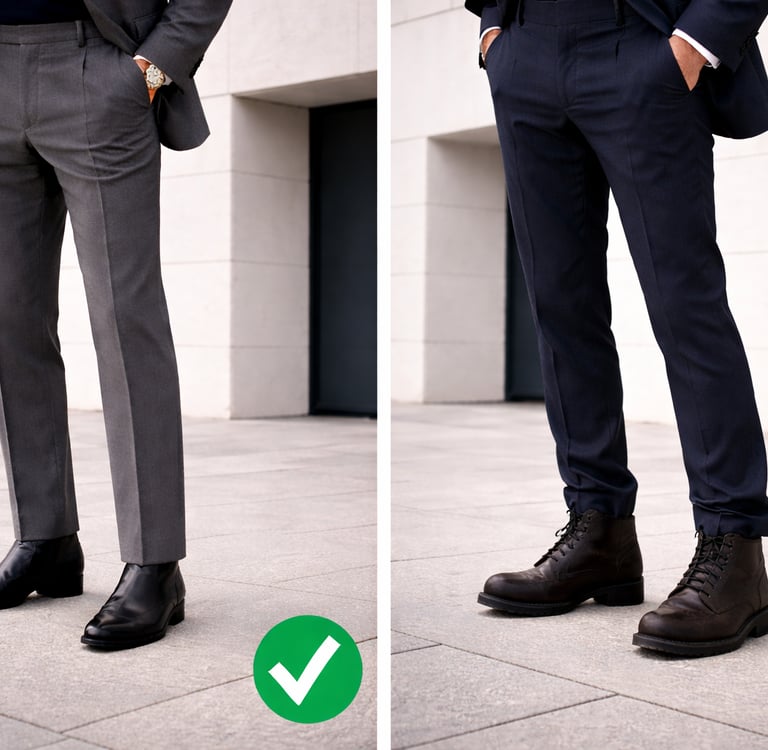
1. Narrow or Refined Boots
(Cuban heels, sleek Chelsea boots, narrow-toe boots)
These boots carry vertical elegance, not bulk.
What they require:
• Length in the trouser.
• A clean, uninterrupted fall.
• Minimal excess width.
Because these boots are narrow, the trouser should follow the leg closely — not tightly, but deliberately. The goal is continuity.
Here, the danger is shortness, not tightness.
If the trouser ends too high, it breaks the line and exposes the boot awkwardly. The eye loses flow.
A well-executed pairing looks effortless because the transition from leg to boot is invisible.
2. Substantial or Heavy Boots
(Service boots, misfit boots, thick-soled designs)
These boots carry presence. They demand acknowledgment.
What they require:
• Length to anchor the silhouette.
• Depth through the hem.
• Enough fabric to sit naturally over the boot.
Trying to pair a heavy boot with a narrow or short trouser creates visual tension. The boot appears exaggerated. The leg looks underdeveloped.
This is where many modern outfits fail.
The solution is not oversized trousers it is intentional volume. Enough fabric to create balance without sloppiness.
When done correctly, the boot feels grounded, powerful, and integrated into the outfit.
The Two Non-Negotiables of Boots and Tailoring
1. Length
Length preserves the vertical line.
It prevents visual interruption.
It communicates confidence and control.
2. Volume (or Depth)
Volume allows the boot to exist without conflict.
It ensures harmony rather than competition.
Without these two elements, tailoring becomes decorative rather than functional.
What Harmony Actually Looks Like
Harmony is when nothing demands attention yet everything looks intentional.
The trouser flows into the boot.
The boot supports the silhouette.
The body appears grounded, balanced, and composed.
This is why well-dressed men often look “effortless.”
The effort was placed in construction, not decoration.
Final Thought: Style Is Structural, Not Decorative
True style begins before trends, before aesthetics, before labels.
It begins with understanding how garments interact.
Boots and tailoring are not separate decisions. They are architectural partners.
When you respect that relationship, your presence changes quietly, but unmistakably.